About
SALON CONCERTS PRESENT
JANUARY CONCERT 2026
JANUARY 4 AT 4:30 P.M. | JANUARY 5 AT 7:00 P.M.
2025–2026 Chamber Series
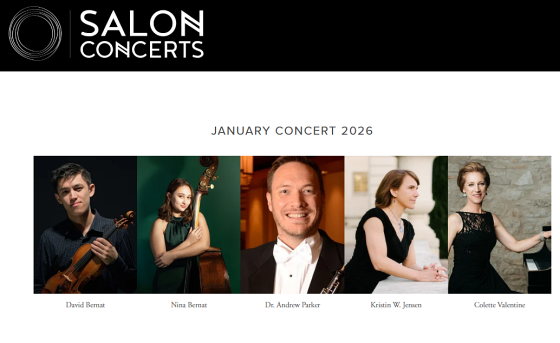
David Bernat, Violin; Nina Bernat, Double Bass; Andrew Parker, Oboe; Kristin W. Jensen, Bassoon; Colette Valentine, Piano
General Admission
Address and directions to the concerts will be sent separately as we get closer to the event date. If you have any questions, please contact salonconcerts@gmail.com or call 512-402-2516.
Specially selected wines and sumptuous catered hors d'oeuvres will be served and are included in the ticket price.
Program:
Passacaglia arranged for Violin and Double Bass…………………………..……………..……………………….Handel-Halvorsen
The Passacaglia with its dual attribution to Handel and Halvorsen is a famous virtuoso piece for violin and cello (or violin and viola) published by Norwegian composer Johan Halvorsen in 1894 and based on the finale movement from the harpsichord suite in G minor (HWV 432) published by German composer Georg Frideric Handel 1720.
Halvorsen was a celebrated violinist, conductor and composer who is remembered today primarily for this brilliant “extrapolation” of Handel’s passacaglia for an ensemble of two stringed instruments. The theme is a brief four-measure sequence of eight chords with a characteristic dotted rhythm generating a series of thrilling variations in a tour de force of musical invention. The Bernat duo has arranged this exciting piece for violin and double bass.
Two-Part Inventions #2, #8, #13 arranged for Violin & Double Bass……………………………………………………....J.S. Bach
Bach’s delightful and varied Two- and Three-Part Inventions for harpsichord are staples in any piano student’s repertoire. The Bernats have arranged some of them for violin and bass.
Disco Toccata………………………………………………………………………...…………Guillaume Connesson
Disco-Toccata by Guillaume Connesson (b. 1970) was originally composed for Clarinet and Cello, and fuses two seemingly unlikely arenas of music: the baroque toccata and the electronic beats of Eurodisco. Although written at a blindingly fast tempo, the dance character and interlocking of the voices share much in common with the Two-Part Inventions by J.S Bach. In place of the ornamentation and improvisation of the Baroque Toccata, the futuristic Disco Toccata employs spontaneously shifting meters and rhythmic patterns to keep listeners (and players!) on their toes.
Grand Trio for Oboe, Bassoon and Piano………………………………………………………………………..Marie De Grandval
Marie Grandval was the pre-eminent French woman composer of the second half of the 19th century. She lived from 1828–1907. She composed extensively, including nine operas and many choral and orchestral works, as well as chamber music, sometimes published under various female pen names. Her friends were well-known composers and other musicians of the time, many of whom were dedicatees of her works, including Bizet, and her composition teacher Saint-Saëns. She studied piano with Chopin.
Many of her works were published, performed and favorably reviewed during her lifetime. She won composition prizes, including the prestigious Prix Chartier for chamber music from the Paris Conservatoire in 1890.
Concerto for Double Bass and Orchestra, arranged for Piano……………………………………………………..Serge Koussevitzky
Serge Koussevitzky is best remembered today as the longtime music director of the Boston Symphony Orchestra (1924–1949) and a major patron of 20th-century music. Before his conducting career, however, he was one of the world’s great double bass virtuosi. A student of Moscow Conservatory bassist Josef Rambousek, he transformed the double bass from a purely orchestral foundation into a solo instrument capable of lyricism and brilliance.
Koussevitzky’s Concerto for Double Bass in F-sharp minor, Op. 3 (1902) is his most enduring composition. He premiered it himself in Moscow in 1905, and it quickly became a central work in the bass repertoire, with soaring melodies and lush harmonic progressions. The concerto demonstrates his aim to show the double bass as an expressive solo voice, not just an orchestral support. Koussevitzky exploits the upper register of the instrument, using harmonics, lyrical high passages, and virtuosic leaps to showcase its solo potential.
Because orchestral resources are not always available, Koussevitzky himself (and later editors) prepared an arrangement with piano accompaniment. The piano writing is dense and orchestral in conception, supporting the bass with harmonic color and rhythmic drive.
Trio for Oboe, Bassoon and Piano………………………….…………………………………………………………Francis Poulenc
A native Parisian, Francis Poulenc associated with the most creative and experimental figures of that legendary time in the 1920s that incubated the chief modernist trends of the early 20th century. Poulenc was part of the informal group of French composers known as “Les Six” whose agenda was to consciously craft a new music separate from the dominance of Germanic Romanticism, the intellectualisms of Schoenberg and the pat associations with Impressionism. Embracing clarity, simplicity, wit and even parody, they refined a genre influenced by Stravinsky and Satie called Neo-classicism. Poulenc was essentially self-taught and, contrary to the fervor of his contemporaries, comparatively conservative. Yet, he is widely prized as a composer for his innate and fertile talents best described as natural, spontaneous and superbly original. His music is colorful, lively, tuneful and engaging, unperturbed by excesses of drama, labored development or rigid form. Poulenc is especially celebrated for his lyricism and his gift for melody. Neo-classical in the best sense, Poulenc's music seems familiar yet fresh, evocative of 18th century classical style with a playful novelty that is purely 20th century. Poulenc excels in musical play; his music is, above all else, fun.
Poulenc had a great fondness for chamber music with winds. Color, pointillistic clarity and poise characterize several frequently featured compositions including his most well known, the Trio for Oboe, Bassoon and Piano of 1926. The first movement, patterned after a particular Haydn allegro is a sparkling presto, a compact caricature of contrasting sections, perfect execution juxtaposed with tongue-in-cheek pratfalls. The middle movement is a soft dream described by Poulenc himself as “sweet and melancholic.” The final movement is another brisk sequence of tableaux, a rondo whose refrain begins as a near perfect quote of a well-known Beethoven melody until it makes a surprising turn into the fresh vocabulary of Poulenc’s own distinctive language. Poulenc hinted that he patterned this movement after a piano concerto by Saint-Saëns perhaps thereby ensuring that the last word was unequivocally French.
BUY TICKETS!
Event Details
- Date: Sunday, January 4, 2026 - Monday, January 5, 2026
- Time: Sunday at 4:30 P.M. | Monday at 7:00 P.M.
- Venue: Address provided with tickets
- Website: https://www.salonconcerts.org/january-concert-2026
Ticket Information
- Cost: $65.00 - $75.00
Presenter Details
- Name: Salon Concerts
Salon Concerts is committed to serving the greater Austin community with excellence in chamber music performance and education.
The mission of Salon Concerts is to foster appreciation and enjoyment of classical chamber music through education and performance. Salon Concerts cultivates the next generation of artists and audiences through increasing exposure and accessibility to chamber music experiences.
Our Chamber Series provides intimate chamber music experiences, featuring professional musicians showcasing a curated repertoire of classical and contemporary music in elegant and interactive settings.